
🌳 Avenues of Influence: From Hunting Parks to Urban Greenspaces
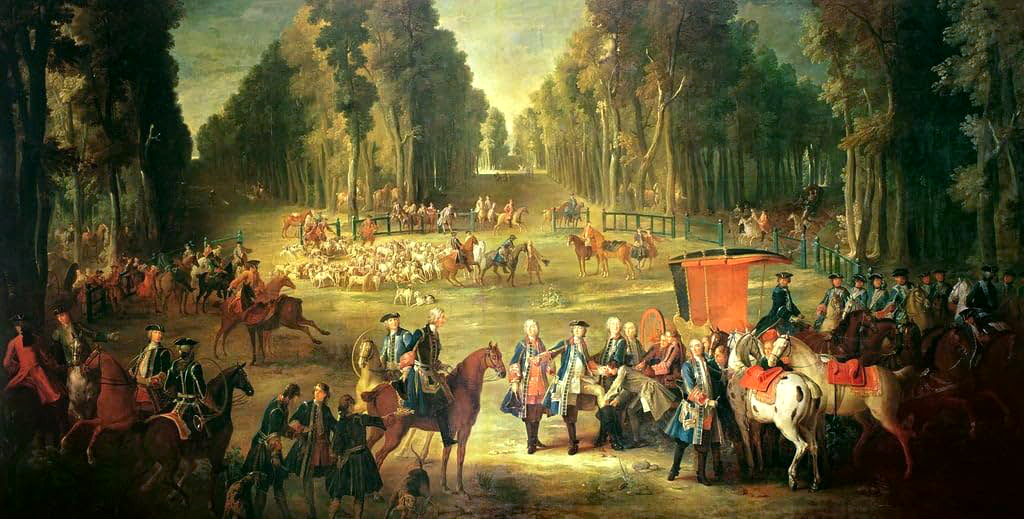
Hunting was a competitive sport for the men and a social activity for their families.

1. Introduction: Why Were Avenues So Popular?

Avenues in French parks and gardens weren’t just aesthetic flourishes—they were strategic, social, and deeply cultural. While beauty played a role, the love of hunting may have been the deeper driver, echoing a tradition that shaped parks across Eurasia for millennia.

2. A Glimpse into 1815: The Spectacle of the Hunt

This vivid account by Harry Smith captures the theatricality of a French-style hunt in a radial forest layout:

“The woods were in perfect order, and cut into beautiful foci and avenues like radii of circles, for hunting in the French style… The carriages, full of ladies of the court and others, assembled in one of the foci… such a crash of horns as there was to denote that the stag had changed his direction!”

The hunt was not just sport—it was performance, pageantry, and social gathering.

3. From Blood Sport to Competitive Sport

Hunting shaped the design of parks in ancient China, India, and the Middle East, and later in Europe. Today, competitive sports have largely replaced blood sports—thankfully—but the integration of aesthetics, athletics, and social life has often been lost.

4. Designing for Integration: A Missed Opportunity?

Modern parks tend to isolate functions. Tennis courts, for example, are often treated as sterile “facilities.” But they could be so much more.

I used to have lunch on the campus of the American University in Cairo, where tennis courts nestled in a shady grove offered seating, shade, and social life. I’d eat falafel, watch the games, and reflect on the Regional Plan for the Suez Canal Zone.

5. Personal Journey: From Practice to Pedagogy

That experience led to reading, writing, and eventually teaching. The team leader, Jac Smit—an inspired American landscape architect—had been influenced by Jaqueline Tyrwhitt (1905–1983) during his time at HGSD. Later, Jac founded Cityfarmer.org, promoting urban agriculture.

6. What’s the Modern Equivalent?

Are today’s parks designed for adventure and big social events, as their predecessors were? Can we reimagine public spaces that blend beauty, sport, and community?


đź”— Join the Conversation

This reflection first sparked discussion on LinkedIn. Feel free to share your thoughts or memories of parks that integrate design, play, and society.


Why were avenues so popular in French parks and gardens? Aesthetics were part of it but a love of hunting may have been a bigger influence, as it was on the creation of parks throughout Eurasia for thousands of years. What is their modern equivalent? This thought was prompted by finding this account (by Harry Smith) of a hunt in French park in 1815: “The woods were in perfect order, and cut into beautiful foci and avenues like radii of circles, for hunting in the French style. The Duke de Berri had hounds, and was passionately fond of the sport. The stag was turned out, there were relays of hounds in couples, and huntsmen of various denominations with large French horns, all in a costume de chasse, with large cocked hats and a couteau de chasse by their sides. The carriages, full of ladies of the court and others, assembled in one of the foci, or centres, from which the avenues radiated. When the stag crossed into another part of the wood, the carriages galloped to the “focus” of that part of the forest where the hunt was now going on, and such a crash of horns as there was to denote that the stag had changed his direction! The Duke went galloping up and down the avenues, changing very frequently from one fat brute of a horse to another. My wife and I, who went out every day and galloped after the Duke, an ill-tempered fellow, up and down the avenues, were barely able to keep our real good hunters warm. It was, however, capital fun, although foreign to our ideas of hunting. I always fancied myself a figure in a tapestry, hunting being a favourite subject for that kind of delineation.”

Are contemporary parks designed for adventure and big social events, as their predecessors were? Hunting was a major influence on parks in ancient China, India and the Middle East. From the middle ages onwards it had a similar influence in Europe. Competive sport has largely replaced blood sports, thankfully. But I regret that aesthetic, social and athletic considerations are not integrated. Tennis courts, for example, are designed as ‘facilities’ and should be integrated with other things. I used to have lunch on the campus of the American University in Cairo which had ( and has?) a super example of tennis courts in a cool shady grove with comfortable spectator seating where I used to eat my falafel, watch the games and think about the Regional Plan for Suez Canal Zone I was working on. That was the professional experience that led me to reading and then to writing and then to teaching. The team leader was a brilliant American landscape architect (Jac Smit) who had been inspired by member of the UK ILA ( Jaqueline Tyrwhitt (1905 – 1983) when he was a student at the HGSD. When he retired Jac set up an Urban Agriculture organisation (Cityfarmer.org). https://lnkd.in/eBQ5C5m8