
What is landscape-led development
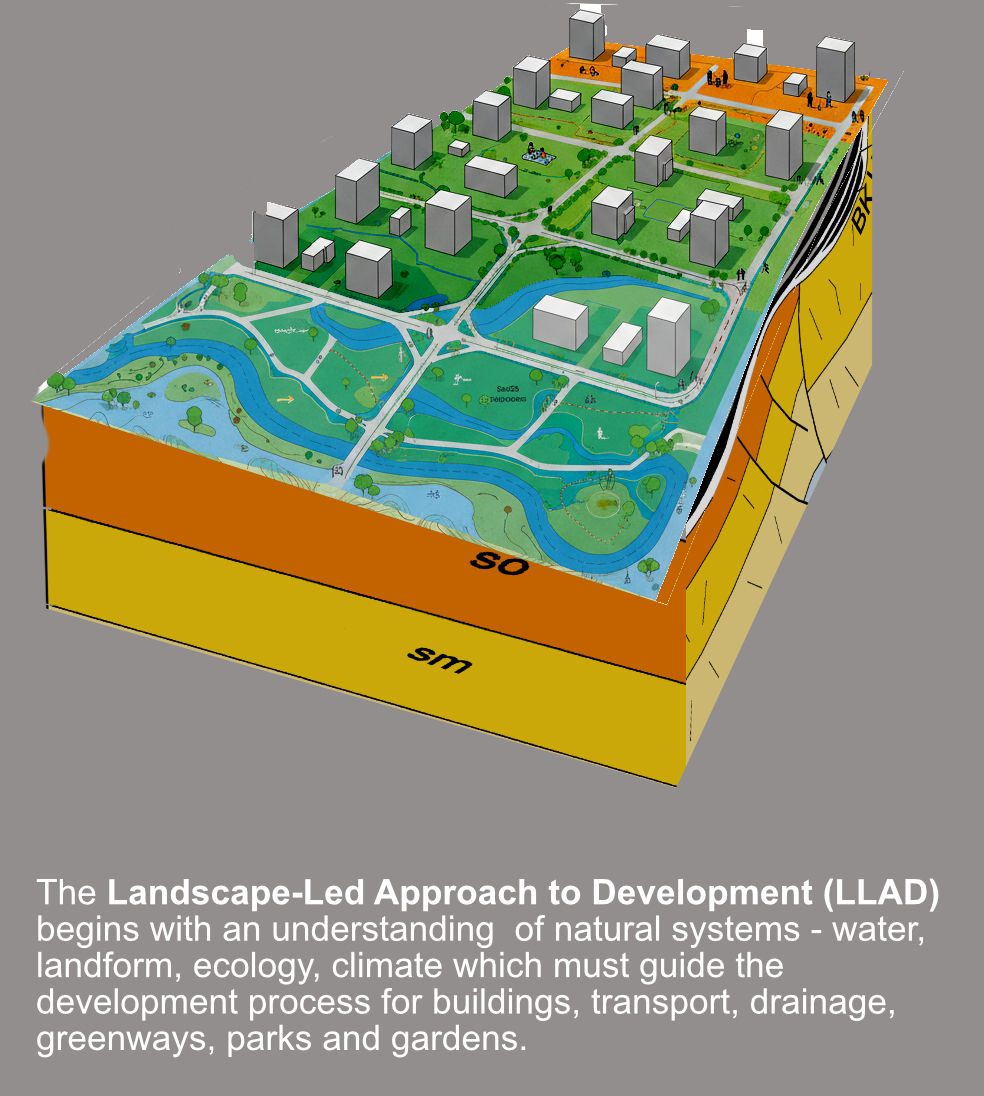
Q. What on earth is Landscape-led Development?
A. It’s concept for reshaping planning and design from the ground up
Over the last decade, “landscape-led development” has moved from professional jargon to policy ambition. The design approach comes from modern landscape architecture’s golden-thread: the design tradition that links Brown, Repton, Loudon, Olmsted, Geddes and McHarg to Dangermond and Steinits.
The term ‘landscape-led development was born in the United Kingdom c2010–2013 and has gained traction in Australia. It signals a re-ordering of priorities (following Brenda Colvin’s Land and Landscape). Development should start with an understanding of the land itself—its topography, water systems, vegetation, and cultural layers—before buildings or infrastructure are conceived, planned and designed.
This deceptively simple idea encapsulates a profound shift in how we make places. It merges ecological science with design creativity. Landscape architects become a pivot in multidisciplinary teams with natural systems at the heart of landscape planning.
Where did the term ‘landscape-led’ came from?
Although the phrase landscape-led development only appears in professional policy papers from the early 2010s, its intellectual roots reach back to Ian McHarg’s Design with Nature (1969). McHarg’s method of overlaying data on soil, hydrology, and vegetation to guide site selection prefigured the notion of letting landscape “lead” the process.
The first formal use of the exact phrase was probably in the Malvern Hills Area of Outstanding Natural Beauty Position Statement (Worcestershire County Council, 2013), which urged that “development should be landscape-led to ensure sensitivity to the AONB’s natural beauty, with landscape architects guiding landform, vegetation, and water integration from inception.”
By the mid-2010s, the UK Landscape Institute (LI) had adopted the term in its advocacy for reform of the National Planning Policy Framework. Its 2025 briefing Maximising Value from Built Development: A Landscape-Led Approach defines it as “putting landscape thinking at the centre of development—engaging experts early to integrate natural systems and deliver economic, social and environmental value.”
Today, the phrase anchors policy debates about biodiversity net gain, green infrastructure, and climate resilience, especially since the UK’s Environment Act 2021 made ecological uplift a legal requirement for most new development.
What does ‘landscape-led’ mean in practice?
Across the professional literature, four inter-linked meanings recur:
- Professional skill – development should be directed by landscape architects rather than architects or engineers.
- Conceptual idea – landscape provides the overarching compositional structure of a place.
- Site survey primacy – design begins with mapping natural and cultural systems.
- Greenspace staging – the “soft landscape” of parks, planting, and water systems forms the first phase of development, shaping later built form.
Different projects stress these elements to different degrees, but all share the principle that landscape is the framework, not the afterthought.
Case study: Thamesmead, London – from modernist utopia to landscape-led regeneration
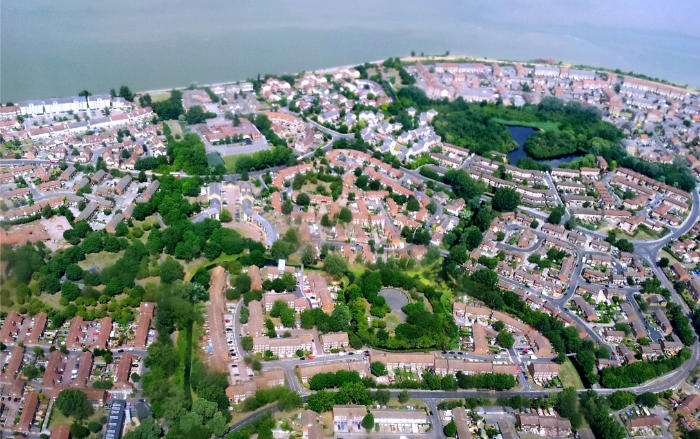
Few places trace the evolution of landscape thinking as vividly as Thamesmead, the 760-hectare new town on the Thames Estuary.
The modernist beginning
In the 1960s, the Greater London Council envisioned a futuristic town for 100,000 people. Derek Lovejoy and Partners, landscape architects for the 1967 masterplan, created an impressive system of lakes and canals to drain the reclaimed marshes. Yet the scheme reflected a landscape-inclusive, not landscape-led, ethos. The designers imposed sculpted, park-like forms more suited to the chalk downs of southern England than to the site’s flat, polder-like terrain. Ecology was secondary to Modernist geometry. Hydrological considerations were treated as a problem to be solved, not as an opportunity to be realised. The plan was not based on the adage of the first UK citizen to use ‘landscape architect’ as a professional title. Patrick Geddes wrote that ‘drains are for cities, not cities for drains.’
The ecological reappraisal
By the 1980s, the landscape consultancy Land Use Consultants (LUC) led a re-evaluation that recognized the site’s true nature: a fragile, low-lying wetland with distinctive biodiversity. Their 1982 Thamesmead Ecology Study championed “working with water,” transforming derelict canals and wartime earthworks—the ‘tumps’, or mounds that once held ammunition—into wildlife habitats. Northern Thamesmead became an early experiment in ecological restoration, foreshadowing today’s emphasis on ecosystem services.
The contemporary phase: Living in the Landscape
Since 2014, housing association Peabody has re-positioned Thamesmead as London’s “greenest town.” Under the leadership of Phil Askew, Director of Landscape and Placemaking, and in collaboration with LDA Design, the Living in the Landscape framework (2021) translates “landscape-led development” into practice. Its priorities include:
- Waterways first: 7 km of canals and five lakes re-engineered for flood resilience and biodiversity.
- Biodiversity networks: the Wilder Thamesmead programme linking ecological tumps via 10 km of trails.
- Community health: co-designed gardens and car-free green corridors boosting daily use of open space from 20 % to 40 %.
Landscape investment precedes building construction. Each new housing phase must demonstrate net ecological gain, improved accessibility, and measurable wellbeing outcomes.
The president of the UK LI (2024-26) cited Thamesmead as “a blueprint for adaptive stewardship”—a model for repurposing post-war estates by embracing their inherited hydrology and biodiversity rather than erasing it.
Complementary example of landscape-led development in Australia
In Australia, the concept has taken root in dense urban contexts such as Surry Hills Village, Sydney (ASPECT Studios, 2018–2025). Here, landscape architects led the design competition, shaping laneways, courtyards, and green roofs before architectural massing was fixed. Green infrastructure was installed early to mitigate heat and manage stormwater, demonstrating that landscape-led principles apply even on tight urban sites.
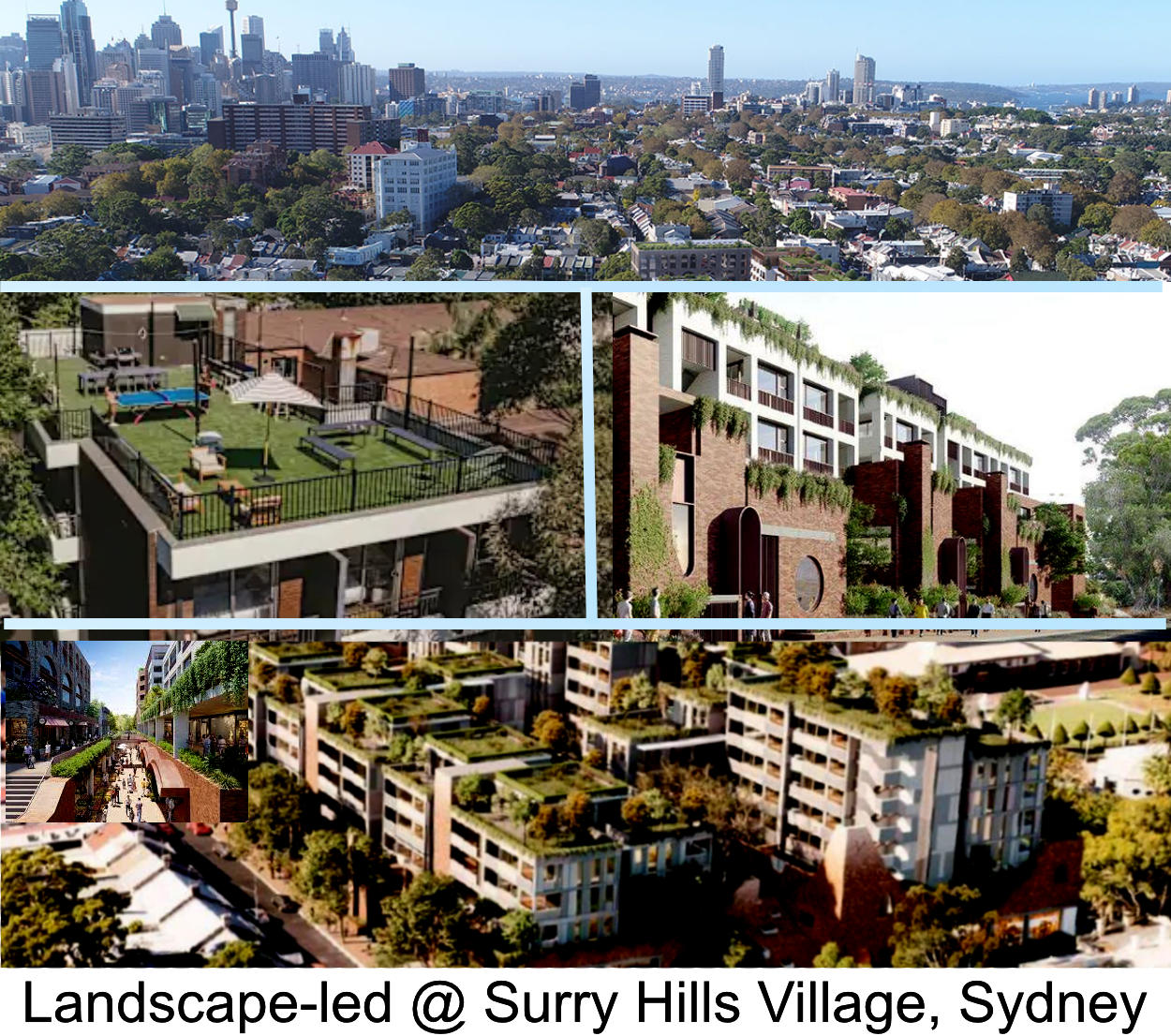
ASPECT Studios led the public space development at Surry HillsBoth Thamesmead and Surry Hills show that “landscape-led” can scale from marshland regeneration to inner-city renewal. What unites them is sequence: the landscape sets the logic to which all else conforms.
What is the relationship of ‘landscape-led’ to ‘landscape urbanism’
Some observers liken landscape-led development to the earlier movement of landscape urbanism (Charles Waldheim, The Landscape Urbanism Reader, 2006). The two share a belief in landscape as the structuring medium for cities, but differ in emphasis. Landscape urbanism was primarily academic and theoretical; landscape-led development is pragmatic and policy-driven, concerned with measurable outcomes such as biodiversity uplift, flood mitigation, and public health.
Why landscape-led matters
- Climate adaptation: Landscapes designed for water retention, shading, and habitat connectivity make developments more resilient to extreme weather.
- Economic value: Research cited by the Landscape Institute shows property value uplifts of around 10 % in landscape-led schemes and long-term maintenance savings through ecosystem services.
- Social equity: When green and blue spaces form the backbone of planning, access to nature becomes a right, not a luxury.
- Cultural continuity: Landscape-led approaches reveal and respect the stories embedded in land—whether the tumps of Thamesmead or the sandstone lanes of Surry Hills.
Challenges and future directions
The landscape-led approach still faces tensions. Some architects see it as constraining design freedom; others fear tokenistic use of “green” language. True landscape-led development demands early commissioning of landscape teams, integrated budgets, and long-term stewardship—conditions often missing in conventional procurement.
Yet momentum is growing. By 2025, more than 40 UK local plans reference the term, and Australia’s planning profession is adopting similar frameworks through the Australian Institute of Landscape Architects (AILA). Globally, the agenda aligns with the UN Sustainable Development Goals, particularly SDG 11 (Sustainable Cities and Communities) and SDG 15 (Life on Land).
Conclusion
From the engineered optimism of the 1960s to the ecological pragmatism of today, Thamesmead’s story captures a wider transformation in professional culture. What began as an attempt to tame the marsh through geometry has evolved into a recognition that the landscape itself is the master-planner.
“Landscape-led development” is therefore more than a design technique—it is a philosophy of humility and collaboration with the living systems that sustain our cities. If the 20th century was defined by architecture shaping land, the 21st century may yet be remembered for land shaping architecture.
Selected References
- Malvern Hills AONB (2013). Landscape-Led Development Position Statement. Worcestershire County Council.
- McHarg, I. L. (1969). Design with Nature. Doubleday.
- Landscape Institute (2025). Maximising Value from Built Development: A Landscape-Led Approach.
- Askew, P. & Göhler, C. (2025). Thamesmead Regeneration: Living in the Landscape. Peabody.
- LDA Design (2020). “Should All Masterplans Be Landscape-Led?” Architects’ Journal.
- ASPECT Studios (2025). Surry Hills Village Project Statement.
- Waldheim, C. (2006). The Landscape Urbanism Reader. Princeton Architectural Press.